Canterbury Bells

Canterbury Bells
Canterbury Bells represent Gratitude in the Language of Flowers

Saturday, March 2, 2013


A wonderful recipe for Beef Bourguignon. Some things take a lot of time and effort....but are so worth it.  Here I am channeling JuliaChild from Mastering the Art of French Cooking...not sure I mastered it, but it was delicious.  So full of robust flavor. And makes such a large portion that easily serves 8-10.   Some things are just worth it.  Bon Appetit!

BEEF BOURGUIGNON

6 oz bacon-cut into small pieces  (I use kitchen scissors—cuts thru easier than a knife)

3 lbs lean beef stew meat  (I cut the meat in smaller pieces than you normally get in a package of stew meat)  A few of the pieces might have some fat which I trim off when cutting into smaller portions)


1 carrot-sliced in thin pieces
1 onion-sliced in thin pieces

salt pepper
1 T flour

3 cups of full bodied red wine or a chianti

2-3 cups beef stock  (I use beef broth or consume in cans—all on soup aisle)

1 Tablespoon tomato paste

2 cloves mashed garlic  (or you can use minced garlic from a jar—about 2 T)
¼ tsp thyme
crumbled bay leaf

18-24 small white onions  (I use 1 frozen package-I thaw them before I put in stew-sometimes the outer skin needs to be slipped off...just squeeze or pinch them after defrosting and it comes off easily)

1 lb. quartered fresh mushrooms sauted in butter

                                                Assembly

Preheat oven to 450 degrees.

In deep Dutch oven or very large sauce pan, saute the bacon in oil over medium heat till lightly brown. (Do not want to burn the oil as we will use it again for carrot and onion)Remove bacon to a side dish with a slotted spoon.

Next is browning the meat in the oil leftover from bacon.  The bacon should have left some additional oil in pan.   Dry the meat between paper towels first. It will not brown if it is damp or moist on outside. Also, brown it in several bathes –not all at once.  You don’t want the meat to be touching each other in the pan.  Remove beef with slotted spoon and add to bacon.

To the same fat, add the carrot and onion.  When they are browned slightly, discard the fat.

Now return the beef and bacon to pan with onion and carrot and toss with salt and pepper to taste.  Then sprinkle on the flour and toss and coat the beef lightly.  Set casserole uncovered in middle position of preheated oven for 4 minutes.  Toss the meat and return to the oven for 4 minutes. 

Remove casserole and turn oven down to 325 degrees.

Stir in wine and enough beef stock or bouillon so that the meat is barely covered.  Add the tomoto paste, garlic,  and herbs.  (You may have to tie up bay leaf in a cheesecloth so it is easy to remove before serving.)

Bring to simmer on top of stove and then place in 325 degree oven for 3 hours.

While the beef is cooking, prepare the onions and mushrooms and set them aside.
(defrost onions and peel away outer skin if necessary)
brown mushrooms in butter

When casserole is done, remove from oven and stir in mushrooms and onions.
Put back in oven for about 20 minutes at a low temperature.

Can be served over noodles or rice....or just plan as a stew with crusty bread.

You can make this all ahead and refrigerate until needed.  Reheat slowly in the oven.  It seems to improve with a little age so it’s perfectly okay to make a few days ahead.

As you can see, it is a lot of preparation but so worth it.  This recipe serves about 8 quite generously.  Could possibly serve 10 if smaller portions.

Enjoy..and please call if you have any questions. 


Friday, February 1, 2013


The Fault in Our Stars by John Green

February is the month we glorify  “love” and The Fault In Our Stars is a glorious love story.   A love story not just between a boy and a girl, but with life itself. You’ll find this book in the Young Adult section but don’t let that keep you from reading it; its message is universal to all ages because it is about living each day to the fullest, as if your days were limited. 

The main characters, sixteen-year old Hazel Grace and seventeen year-old Augustus (Gus)Waters, live and love that way because they have cancer.  They don’t fall into the trap healthy people do of thinking they have all the time in the world. As one review says, (Gus) was “carpe diem” personified. 

Hazel and Gus meet at a cancer support group which Hazel goes to reluctantly at her mother’s urging because Hazel has few friends these days and prefers the company of books, particularly the fictional An Imperial Affliction by the Dutch author Peter Van Houten. I mention this book and its author because they play a critical role in the plot, both externally and internally.  As Van Houten tells Hazel, “Grief doesn’t change you; it reveals you.”

Also at the support group is Gus’ best friend Isaac.  Isaac loses an eye to cancer and finds solace in Hazel and Gus (and his video games) when his girlfriend dumps him.  So here’s the cast of teen characters: Isaac who is blind, Gus who is in remission from osteosarcoma, which cost him a leg and a starting line-up on the Hoosier high school basketball team, and Hazel, a thyroid cancer patient on a “miracle” drug that can supposedly lengthen her life—a life that consists of having oxygen tubes in her nose 24/7 with a tank she hauls around with the grace of a trendy purse.  If you are thinking you don’t want to read a downer book, let me assure you that although you may shed a few tears, you will also laugh and be inspired as these three banter and face life with amazing courage and valor.  Hazel herself admits on page one, “...cancer books suck.” She is referring to clichés and sentiment that conceal hard truths. The voices of these three characters however ring brutally true with no sugar coating.

Narrated in first person, Hazel’s voice is unforgettable. It could also be described as insightful, honest, witty and genuine.  Hazel’s one normal high school friend, Kaitlyn, provides comic relief but Hazel considers her mother her best friend as she takes every opportunity to be enthusiastic at small occasions, such as half-birthdays and Bastille Day.  Their relationship however is tested when Hazel starts spending most waking hours with Gus, leaving little energy to be with her loving and supportive parents. As Hazel rebuttals, “But you said I spend too much time alone...you wanted me to have friends.” Inside Hazel fears for her parents’ welfare—she would do anything to spare them grief. She read a statistic that half of all marriages result in divorce after a child’s death. As an only child she fears, “What will happen to them if she dies?” This is the same reason she is initially reluctant to go beyond friendship with Gus--to spare him further sadness and angst.  Gus’ persistence however wins her over, especially when he shares her love for An Imperial Affliction and together they take on a mission and journey inspired by the book—with a little help from the Genies (The fictional Make-A-Wish foundation).

The title of the book, according to the author’s blog, is inspired by a line from Shakespeare’s play, Julius Ceaser, where the nobleman Cassius says to Brutus,
“The fault, dear Brutus, is not in our stars, but in ourselves, that we are underlings”.
His blog also tells us that he named the main character Hazel “because it’s an in-between color, and she has an in-between life, in-between health and sickness.”

It’s challenging to comment fully on the beauty of this story without plot spoilers so you’ll have to trust me on this one. Or better yet, trust the millions of readers author John Green has.  Fault In Our Stars debuted in January 2012 as #1 on the NY Times Best Seller list for Children’s Chapter Books and remained in that spot for seven consecutive weeks. It was #1 on the Wall Street Journal bestseller list and as of January 2013 had one million copies in print world-wide.  In February, 2012, film rights to the book were optioned by Fox 2000.

Also, an interesting note that speaks volumes of the author’s amiable character as well as his fan loyalty:  On December 21, 2011, Barnes and Noble accidentally shipped 1500 copies of the book three weeks before its release date to people who had pre-ordered the book.  Green released a statement saying, “Mistakes happen. It is not my wish to see any employees vilified.” Many fans who received the book pledged not to read it until its release date as per a request of Green’s to not spoil it for other readers.

As of January, 2013, John Green has three other spots on the New York Times Best Seller list: Looking for Alaska, An Abundance of Katherines, and Paper Towns.  Green is somewhat of a paradox.  All of his novels are about serious subjects portrayed with wit and soulfulness through the eyes of highly intelligent teenagers. Yet his sideline is funny stuff.  He is one half of the Vlogbrothers (youtube.com/vlogbrothers), a popular online video, social media project.  He co-founded a still running public reading series, Funny HaHa when he lived in Chicago. You can join John’s 1.2 million followers on Twitter (@realjohngreen), or visit him online at johngreenbooks.com.

Although these characters have a fault in their stars, when finished with this book you are left grateful that you knew them and that the stars of those you love are healthy.


Thursday, January 10, 2013


Happier at Home by Gretchen Rubin

January. Resolutions. My guess is that at least one of your resolutions falls under the category of being happier in some area of your life.  If so, you might want to take a look at Gretchen Rubin’s new book Happier at Home (2012).  Her previous book, The Happiness Project was #1 on the NY Times bestseller list for months.  Although I hadn’t read that one, I bought her next book as the “perfect” gift for someone. Before I wrapped it I skimmed it a little further than in the bookstore. Soon I was reading each page and knew I had to have my own copy.  This is a valuable and inspirational reference for any individual, family or home--the kind of book you might not read at one sitting or from beginning to end, but snippets on a daily or weekly basis. With a highlighter.

This book is not just Rubin’s personal philosophy which one might think, “Well, how can someone else’s idea of happiness be the same as mine?”  But rather she has studied the field intensively and shared many philosophies. One reviewer calls it a cross between the Dalai Lama’s The Art of Happiness and Elizabeth Gilbert’s Eat, Pray, Love.  I personally think the seven-page bibliography of books and extensive research that she includes is worth the price of the book alone.  The books that have most influenced her life and this project are The Autobiography of Benjamin Franklin,  (Yale Press), Therese of Lisieux’  spiritual memoir, Story of a Soul, and everything written by Samuel Johnson.

In Happier at Home, Rubin says, “A happiness project is an approach to the practice of everyday life. The key word here is everyday.  Let’s face it...most of our time is spent in “everyday” living, not at DisneyWorld.  What better place to find the joie de vivre than in our daily tasks.  First is the preparation stage where you identify what brings you joy, satisfaction and engagement as well as what causes you frustration or unhappiness? Second is the making of resolutions, where you identify what actions will bring joy and reduce the opposite. Then comes the interesting part: keeping your resolutions.”

Rubin divides her book into nine sections, for the months of September through May, much like a school year with each month devoted to focusing on an aspect of daily living:  Possessions, Marriage, Parenthood, Interior Design, Time, Body, Family, Neighborhood, and Now.  Although those were the months she chose to focus, the principles and ideas could apply to any month or person’s schedule.

As she labored to identify the fundamental principles that underlay happiness, she identified what she calls Four Splendid Truths.

To be happy, I need to think about feeling good, feeling bad and feeling right in an atmosphere of growth.
One of the best ways to make myself happy is to make other people happy.
The days are long, but the years are short.
I’m not happy unless I think I’m happy.  (credit to the artist Delacroix)

I might add a quote here that is credited to Abraham Lincoln: “We’re about as happy as we make up our minds to be.”

Here’s an example of one of Rubin’s suggestions under Parenthood:  Give Warm Greetings and Farewells.  Seems simple enough and we might say, “Well, I do that all the time already”.  But she tells of an anecdote where she ignored her own advice due to life pressures,  and time crunches. The child called her on it, which told her it had become meaningful in her life.  Rubin’s style is not preachy but very real from trial and errors of daily living.

Tolstoy said, “Each time of life has its own kind of love.”  Rubin says she didn’t want the time her young children were at home to slip past, unrecognized and unremembered.  Any parent will appreciate her “bus” incident. It is priceless and confirms, the days are long, the years are short.

I found one of the most interesting sections to be the one on Possessions.  Or as we often call it, our Stuff.  How much stuff do we need? How happy does it make us?
She addresses these issues in a way that causes one to think of their relationship to their possessions.  Her process makes it so much more than a “How To Get Organized” column.

“Cultivating possessions isn’t a simple matter of organization, elimination or accumulation; it is a matter of engagement.  When I felt engaged with my possessions, I felt enlivened by them and when I felt disengaged I felt burdened.”
Engagement can take the form of both use and response.  For example, if every time we walk by a certain photograph we have on display we feel a sense of joy remembering the occasion, we are definitely engaged!  And on the opposite end of the spectrum, the frustration we experience when new gadgets or equipment causes us grief.   As technology rapidly caused the author to master new skills almost on a weekly basis—the DVR, the downloading of ITunes, the uploading of photos, the countless remotes --she realized these possessions were more frustrating than valuable.  Then she applied her first rule:  Identify what causes unhappiness and correct it. Read the manual, the instructions, or else get rid of something we will never take the time to figure out but merely frustrates us each time we see it.

There is an interesting chapter on creating the space we spend most of our time in, be it at work, our office at home, our kitchen, so that it is a pleasurable place to be.
In doing so she discovers a Fifth Splendid Truth.  I can build a happy life on the foundation of my own nature.  I think this resourceful book can help one discover their own true nature as well as more Splendid Truths. 

Rubin has written other non-fiction, such as Forty Ways to Look at JFK, and Forty Ways to Look at Winston Churchill. She began her career as a lawyer and was working for Supreme Court Justice Sandra Day O’Connor when she realized she wanted to be a writer. She currently resides in New York City with her husband and two daughters.  If you’d like to sample her writing, you can visit her daily blog:  www.happiness-project.com.  I bet you’ll be happy you did.


Friday, December 28, 2012

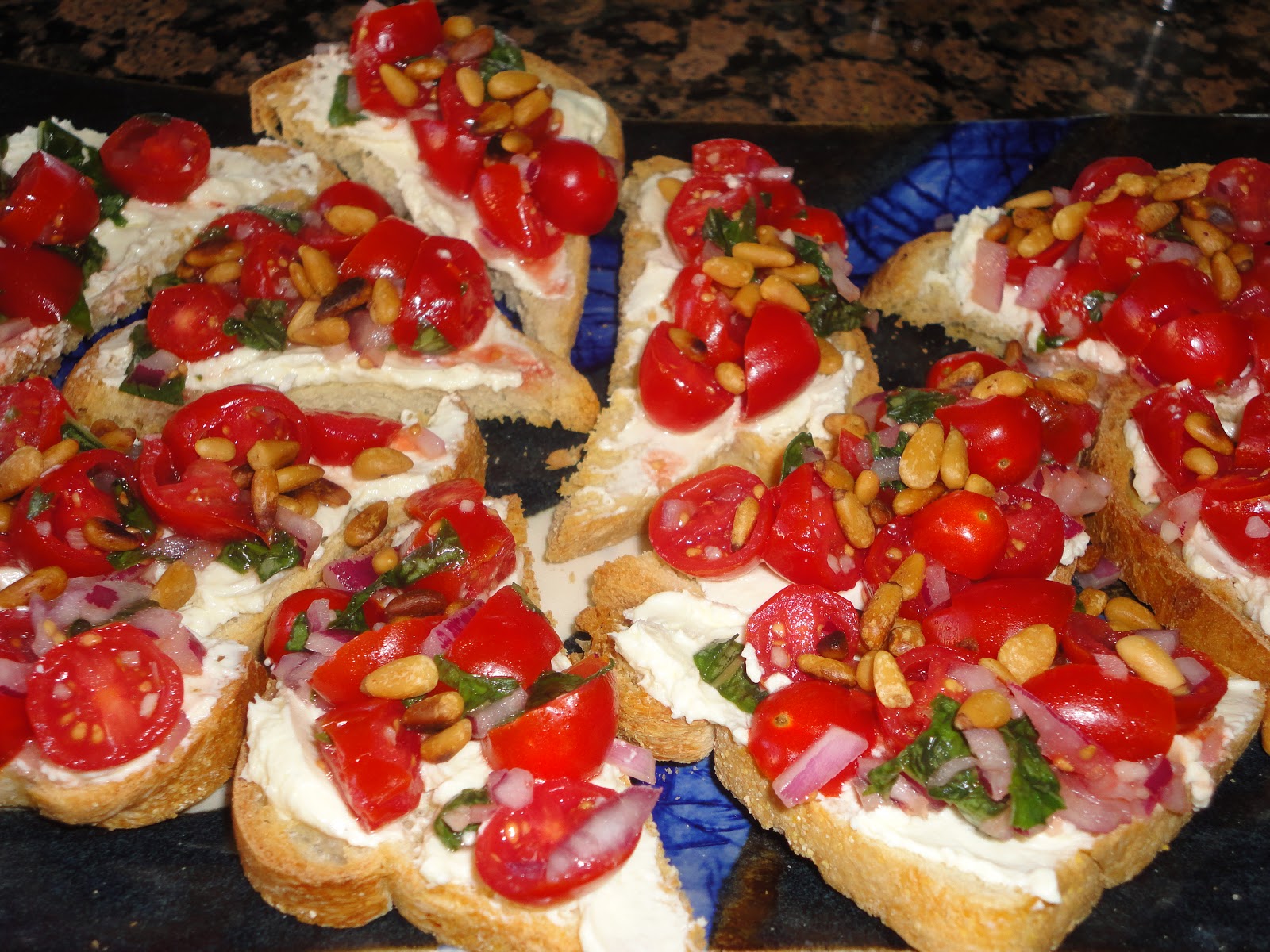
A delicious and lovely Tomato Crostini...perfect colors for the holidays!
(I'd like to take full credit but it is from Barefoot Contessa's new book of "foolproof recipes".  So far so good...I've tried 3 of them.


Tomato Crostini with Whipped Feta

6 oz feta cheese crumbled
2 oz cream cheese at room temp
2/3 cup olive oil   (divided)
2 Tablespoons freshly squeezed lemon juice
Kosher salt and freshly ground pepper
2 Tablespoons minced shallots (1 shallot)
2 teaspoons minced garlic or 2 cloves
2 Tablespoons red wine vinegar
2 lbs. ripe cherry tomatoes-diced in ½ in pieces
2 Tablespoons fresh julienned basil leaves
20-25 diagonal cut baguette slices (I used English muffin sliced bread which I toasted in oven)
2 Tablespoons toasted pine nuts for garnish


Put both cheeses in food processor with steel blade and pulse till blended.
Add 1/3 cup of the olive oil, lemon juice and ¼ teaspoon salt and pepper till all smooth.
Cut up tomatoes about an hour before serving, combine with shallots, garlic, vinegar in a medium bowl. Let sit for about 5 minutes. Whisk in remaining olive oil (1/3 cup) 1 teaspoon salt and ¼ teas. Pepper. Stir gently and set aside for 10 minutes. Stir in the basil and taste for seasoning.

To assemble the crostini, spread each slice of bread generously with whipped feta mixture. With a slotted spoon place the tomatoes on top. Put the crostini on plate and scatter with pine nuts.  Can add additional chopped basil if desired.

This recipe takes a little time, but it is so worth it...both in presentation and taste.

Tuesday, December 18, 2012


“HAVE A WORRIED THOUGHT?

      REPLACE IT WITH A BRAVE THOUGHT”

I read this quote this week in the massive coverage of the Sandy Hook tragedy. I think it was in a letter of advice to parents on how to dispel worries children might voice after experiencing such trauma.  As one young survivor of the tragedy told her mother, “But I just can’t stop thinking about it.”  Mother suggested she replace this worry thought with a brave thought.  What wonderful counseling for a frightened child.

My three –year- old granddaughter Maribelle uses the word brave often. I thought this was kinda peculiar as I don’t recall ever using that word as a child.  But then again she is being raised at West Point Military surroundings with its many statues and memorials where her father talks to her about George Washington and how brave the soldiers were.

Then I thought too of all the countless fairy tales and Disney hero adventures children are exposed to in books, TV and movies.  Brave is BIG.  Brave is even what Princesses now practice. It’s a good thing!

This idea of replacing worry with brave came to mind many times this week as I heard too often how many children were lost and we see little children attending the funeral of little friends.  It is not a pleasant scene, yet it is right to be brave. I think it doesn’t mean we don’t cry. It means we do something that is right even though we might be afraid or uncomfortable.

And I thought, how many adults could use this same mantra?   Who doesn’t want to be brave?  Who wouldn’t want a quick and doable formula for dispelling those worrisome thoughts that creep into our heads as we’re doubting ourselves, or awake in the night imagining the worst, or fearing for a family member’s safe arrival while traveling?  Or giving ourselves a pep talk when facing an uncomfortable situation.

So hopefully out of this horrific tragedy of Sandy Hook-- perhaps something can be salvaged.  A way to teach the living children to deal with fears and worries....something we humans are all plagued with throughout our lives.  Let’s try hard to redeem something good—small as it may be—of this awful event. Let’s be a brave example to those around us—especially children.  And may 20 little souls rest in peace—no longer a need to be brave –simply angelic.


Sunday, December 16, 2012


Lost and Found

I’m SUCH a loser. Now before you try to be kind and tell me I have some redeeming qualities, let me clarify.  I am a loser—literally.  I lose so many things.  Little things, big things, cheap, expensive, important and not so important, but still...
For example, I have a drawer in my jewelry box that contains only single earrings.  I have lost their mates. ( I’ve learned that as soon as I throw out the single, the other one miraculously appears,  in a purse or dangling from a necklace I haven’t worn in ages).

I’m also a leaver. Hats, gloves, scarves, jackets—anything not attached to my body has been left behind somewhere. I hope whoever finds my stuff enjoys it-- small consolation but I hope someone in Boston is now enjoying my favorite fuschia golf cap -- left in the women’s stall at the Boston Acquarium-- or someone in  Newburgh, New York has use for a SONY camera battery and charger which fell out of of carry-on at the airport.

I know now where the expression ”If my head weren’t attached...” comes from. It’s a wonder I didn’t lose Tim or Berta when they were babies.

Latest loss:  Last week I had an audition at the casting studio at noon and a Christmas party there the same night at six. Rather than drive the 50 mile round trip home and back, I decided to hang out at the beautiful Biltmore Shopping Plaza which was just a few miles from the studio.

I had lunch at the Cheesecake Factory and then sat on one of the picnic benches in the promenade—it was a beautiful day.  I made some phone calls and then went window shopping with a final stop at Macy’s. 

Hours later I pulled into the casting studio parking lot a bit early for party and thought I would review the monologue which I was a performing that night.  I had put it in the cover of my Kindle. No Kindle to be found anywhere.  Begins the frantic search and that awful feeling in the pit of the stomach...oh no, not again.  Under car seats, in purses, in bags on seat, glove compartment.  Then I remembered I took the Kindle to lunch with me in case I would read during my solo lunch.

No time to return to the Biltmore.  Frantic memory trace of my steps.  Only purchase was at Macy jewelry department where I bought a pair of earrings for my niece (sorry for plot spoiler if you’re reading this Alycin).  Do you know how hard it is to find a human...”enter your account number, your balance is,  your available credit is...”
Finally... a live voice. Customer service promises to call me should a Kindle turn up.

Then I call Cheesecake Factory. No Kindle there.  I talk to the nicest manager however...SO nice that I sheepishly ask him a stupid question, “I know it’s a long shot but could you please have someone check the picnic bench between you and Paradise Bakery? “   This four hours after I sat on the bench...dream on.
 “Sure, no problem! I’ll check with the Bakery manager too”.  This young man’s mother would haven been so proud of her son’s courtesy and kindness.

Then one more moment of panic. My credit card number is tied to the Kindle. What if an avid reader, an unscrupulous avid reader found the Kindle and with one touch of the finger starts downloading –every book he or she has ever wanted.  Charged to my card.

I make one more call...Wells Fargo. Please cancel my card.  I know that card is tied in to other automatic payments, but in my best Scarlett O’Hara voice I tell myself I will deal with that tomorrow.

Short story long:  Cheesecake man calls me back. Someone turned Kindle in to Paradise Bakery and he took  it to the mall office.

I think “Yes, Virginia there is a Santa Claus.”

After profound thanks and vowing to eat at the Cheesecake Factory once a week for the rest of my life (what a sacrifice) I go to the party worry-free.

P.S . What prompted this blog was the fact that when I left the house this morning I couldn’t find my favorite Chico jacket...I think I left it on the plane when our red-eye from Hawaii was cancelled.   See what I mean—a literal loser /leaver, whatever.

A final note to my son Tim and DIL Bette Anne:  I’m told grandson Kevin has loser “issues”.  Please don’t be too hard on him.  I think it’s in the DNA.


Thursday, December 13, 2012


Beautiful Ruins by Jess Walter

If you are still looking for a Christmas gift for the reader in your family, male or female, I think they’ll thank you for placing Beautiful Ruins under the tree well into the new year.  And you’ll enjoy the sound of their laughs-out-loud as they turn the pages.

I don’t recall what prompted me to read Beautiful Ruins by Jess Walter a few months ago.  I had never heard of him although he has written five other successful novels, including  The Zero, a National Book Award novel about 9/11 and The Financial Lives of Poets, a satire on our economic crisis.  Nor do I recall anyone recommending the book.  So I am so thankful that somehow I stumbled onto it because it is a GEM. 

I’m going to fudge a little here and copy the description of the book on the front flap of the book cover because it summarizes so much so well (and frankly, I still have a lot of Christmas shopping to do) and then delve into some of my personal favorite highlights.  There is way too much to talk about.  The beautiful and funny writing, the unique and so varied characters, the settings—Italy, Hollywood, Idaho, the Northwest. 

From the book jacket:
The story begins in 1962. On a rocky patch of the sun-drenched Italian coastline, a young innkeeper, chest-deep in daydreams, looks out over the incandescent waters of the Ligurian Sea and spies an apparition: a tall, thin woman, a vision in white, approaching him on a boat. She is an actress, he soon learns, an American starlet, and she is dying.

What unfolds is a dazzling, yet deeply human, roller coaster of a novel, spanning fifty years and nearly as many lives. From the lavish set of "Cleopatra" to the shabby revelry of the Edinburgh Fringe Festival, Walter introduces us to the tangled lives of a dozen unforgettable characters: the star-struck Italian innkeeper and his long-lost love; the heroically preserved producer who once brought them together and his idealistic young assistant; the army veteran turned fledgling novelist and the rakish Richard Burton himself, whose appetites set the whole story in motion--along with the husbands and wives, lovers and dreamers, superstars and losers, who populate their world in the decades that follow. Gloriously inventive, constantly surprising, "Beautiful Ruins" is a story of flawed yet fascinating people, navigating the rocky shores of their lives while clinging to their improbable dreams.

I’ll start my comments with Jess Walter’s writing.  One book reviewer calls his work a literary miracle. Walter captures scenes that create beautiful imagery.  For example, the opening scene in the tiny fictional Italian coastal village of Porto Vergogna

She (the dying American actress) arrived in a boat that motored into the covey, lurched past the rock jetty, and bumped against the end of the pier...All around her shards of sunlight broke on the flickering waves. Twenty meters away Pasquale Tursi was attempting to construct a beach under his family’s empty Pensione (Hotel). He watched as if in a dream or as he would think later, a dream’s opposite--a burst of clarity after a lifetime of sleep.  Chest deep in the cold Ligurian sea, Pasquale was tossing rocks the size of cats in an attempt to fortify the breakwater, to keep the waves from hauling away his little mound of construction sand. Pasquale’s “beach” was only as wide as two fishing boats and the ground beneath his dusting of sand was scalloped rock.  It was the closest thing to a flat piece of shoreline in the entire village. 

When the actress Dee Moray smiles at him Pasquale falls in love and would remain in love for the rest of his life—not so much with the woman, whom he didn’t even know, but with the moment. 

What follows is a description of the ancient dilapidated hotel, the improbable beach designed purposely to attract wealthy Americans such as the Kennedys, the plans to build a tennis court on a jutting piece of rock—all as futile and ridiculous as the name itself: Hotel Adequate View.

Another example of Walter’s way with words:  Porto Vergogna translates as Port of Shame-so called because it was once a place where sailors and sardine fishermen could find women of “a certain moral and commercial flexibility”.

Although filled with boundless comic passages, a favorite I cannot resist enticing you with is that of Michael Deane, the once famous Hollywood producer of the 70’s and 80’s, the “Deane of Hollywood” now reduced to producing a reality dating show called Hookbook. 

The first impression one gets of Deane is a man constructed of wax. It may be impossible to trace the sequence of facials, spa treatments, mud baths, cosmetic procedures, lifts and staples, collagen implants, outpatient touch-ups, tannings, Botox injections, cyst and growth removals and stem-cell injection that have caused a 72-year old man to have the face of a 9-year old Filipino girl.

Trying to picture what Michael Deane looked like as a young man in Italy fifty years ago is like standing on Wall Street trying to understand the topography of Manhattan Island before the Dutch arrived.

Moving on to characters and plots We’ve all read novels with multiple plots emerging and wondering how they would all pull together satisfactorily by the end of the book.  Often, we feel we’ve been manipulated or perhaps the culmination was a little unrealistic.  Not so with this story.  It comes together beautifully and leaves one with a sense that all is well with the human condition.  In a sense it is also good vs. evil (not blatantly like Star Wars) but more like in It’s a Wonderful Life or Willie Wonkie (all good deeds Charlie shall be rewarded...or something like that).

One storyline is with young and very likeable film student Claire, who works for producer Deane reading scripts, hoping to discover the next literary masterpiece but instead being inundated with realty TV show pitches featuring drunk models or sex addicts—scripts so offensive that to give them the green light for production would be akin to “singlehandedly hastening the apocalypse.”  Should she take the new job offer at the new Film Museum-- and while dumping her old job should she also dump her boyfriend whose favorite pastime is girlie shows and strip clubs? 

Then there’s Shane Wheeler, another down on his luck wannabee screenwriter who is about to, against all odds, successfully pitch a movie to Deane called “Donner!” Yes, it’s about the Donner party and story comprises one entire chapter.  We find ourselves also rooting for Shane who for all of his young life lived with the philosophy his loving parents instilled: act as if you can do something and you can do it. This creed has served him well until recently.

Then there is Elvis, a failed American writer and alcoholic veteran. As a once a year visitor to the Hotel Adequate View, he leaves his World War II novel in his room—actually just the lone chapter he continually rewrites every year for two weeks each summer.

Then there is the cameo appearance of the real life Richard Burton who is in Italy for the filming of Cleopatra—the scandal-ridden Elizabeth Taylor/Richard Burton epic, with a budget of about 300 million of today’s dollars.  I thought the title Beautiful Ruins referred to the rock formations on the Italian coast but it appears that Burton himself might be the ruin they are referring to.  They describe a scene where he appeared on the Dick Cavett show in the 80’s, at age 54, looking quite ruined.

And of course, the main characters—Dee Moray, the American actress and Pasquale Tursi.  I do not want to give a plot spoiler and reveal how and why all these characters unite to bring the novel to a satisfying conclusion. Perhaps it is the Hollywood influence but one can almost hear the swelling soundtrack at the end. 

If you are a fan of audio books, I highly recommend that you listen to this one instead of read it as the narrator, Edwardo Balarini,          brings Pasquale to life with his beautiful Italian accent. Ladies, you will fall in love with this sweet and humble, azure-eyed Italian. In my book, he joins the ranks of Heathcliff and Rhett Butler.

Beautiful Ruins is a great escape read and storytelling at its best with the right blend of pathos and comedy.  

Merry Christmas to all ...and to all a good book.