Canterbury Bells

Canterbury Bells
Canterbury Bells represent Gratitude in the Language of Flowers

Thursday, January 10, 2013


Happier at Home by Gretchen Rubin

January. Resolutions. My guess is that at least one of your resolutions falls under the category of being happier in some area of your life.  If so, you might want to take a look at Gretchen Rubin’s new book Happier at Home (2012).  Her previous book, The Happiness Project was #1 on the NY Times bestseller list for months.  Although I hadn’t read that one, I bought her next book as the “perfect” gift for someone. Before I wrapped it I skimmed it a little further than in the bookstore. Soon I was reading each page and knew I had to have my own copy.  This is a valuable and inspirational reference for any individual, family or home--the kind of book you might not read at one sitting or from beginning to end, but snippets on a daily or weekly basis. With a highlighter.

This book is not just Rubin’s personal philosophy which one might think, “Well, how can someone else’s idea of happiness be the same as mine?”  But rather she has studied the field intensively and shared many philosophies. One reviewer calls it a cross between the Dalai Lama’s The Art of Happiness and Elizabeth Gilbert’s Eat, Pray, Love.  I personally think the seven-page bibliography of books and extensive research that she includes is worth the price of the book alone.  The books that have most influenced her life and this project are The Autobiography of Benjamin Franklin,  (Yale Press), Therese of Lisieux’  spiritual memoir, Story of a Soul, and everything written by Samuel Johnson.

In Happier at Home, Rubin says, “A happiness project is an approach to the practice of everyday life. The key word here is everyday.  Let’s face it...most of our time is spent in “everyday” living, not at DisneyWorld.  What better place to find the joie de vivre than in our daily tasks.  First is the preparation stage where you identify what brings you joy, satisfaction and engagement as well as what causes you frustration or unhappiness? Second is the making of resolutions, where you identify what actions will bring joy and reduce the opposite. Then comes the interesting part: keeping your resolutions.”

Rubin divides her book into nine sections, for the months of September through May, much like a school year with each month devoted to focusing on an aspect of daily living:  Possessions, Marriage, Parenthood, Interior Design, Time, Body, Family, Neighborhood, and Now.  Although those were the months she chose to focus, the principles and ideas could apply to any month or person’s schedule.

As she labored to identify the fundamental principles that underlay happiness, she identified what she calls Four Splendid Truths.

To be happy, I need to think about feeling good, feeling bad and feeling right in an atmosphere of growth.
One of the best ways to make myself happy is to make other people happy.
The days are long, but the years are short.
I’m not happy unless I think I’m happy.  (credit to the artist Delacroix)

I might add a quote here that is credited to Abraham Lincoln: “We’re about as happy as we make up our minds to be.”

Here’s an example of one of Rubin’s suggestions under Parenthood:  Give Warm Greetings and Farewells.  Seems simple enough and we might say, “Well, I do that all the time already”.  But she tells of an anecdote where she ignored her own advice due to life pressures,  and time crunches. The child called her on it, which told her it had become meaningful in her life.  Rubin’s style is not preachy but very real from trial and errors of daily living.

Tolstoy said, “Each time of life has its own kind of love.”  Rubin says she didn’t want the time her young children were at home to slip past, unrecognized and unremembered.  Any parent will appreciate her “bus” incident. It is priceless and confirms, the days are long, the years are short.

I found one of the most interesting sections to be the one on Possessions.  Or as we often call it, our Stuff.  How much stuff do we need? How happy does it make us?
She addresses these issues in a way that causes one to think of their relationship to their possessions.  Her process makes it so much more than a “How To Get Organized” column.

“Cultivating possessions isn’t a simple matter of organization, elimination or accumulation; it is a matter of engagement.  When I felt engaged with my possessions, I felt enlivened by them and when I felt disengaged I felt burdened.”
Engagement can take the form of both use and response.  For example, if every time we walk by a certain photograph we have on display we feel a sense of joy remembering the occasion, we are definitely engaged!  And on the opposite end of the spectrum, the frustration we experience when new gadgets or equipment causes us grief.   As technology rapidly caused the author to master new skills almost on a weekly basis—the DVR, the downloading of ITunes, the uploading of photos, the countless remotes --she realized these possessions were more frustrating than valuable.  Then she applied her first rule:  Identify what causes unhappiness and correct it. Read the manual, the instructions, or else get rid of something we will never take the time to figure out but merely frustrates us each time we see it.

There is an interesting chapter on creating the space we spend most of our time in, be it at work, our office at home, our kitchen, so that it is a pleasurable place to be.
In doing so she discovers a Fifth Splendid Truth.  I can build a happy life on the foundation of my own nature.  I think this resourceful book can help one discover their own true nature as well as more Splendid Truths. 

Rubin has written other non-fiction, such as Forty Ways to Look at JFK, and Forty Ways to Look at Winston Churchill. She began her career as a lawyer and was working for Supreme Court Justice Sandra Day O’Connor when she realized she wanted to be a writer. She currently resides in New York City with her husband and two daughters.  If you’d like to sample her writing, you can visit her daily blog:  www.happiness-project.com.  I bet you’ll be happy you did.


Friday, December 28, 2012

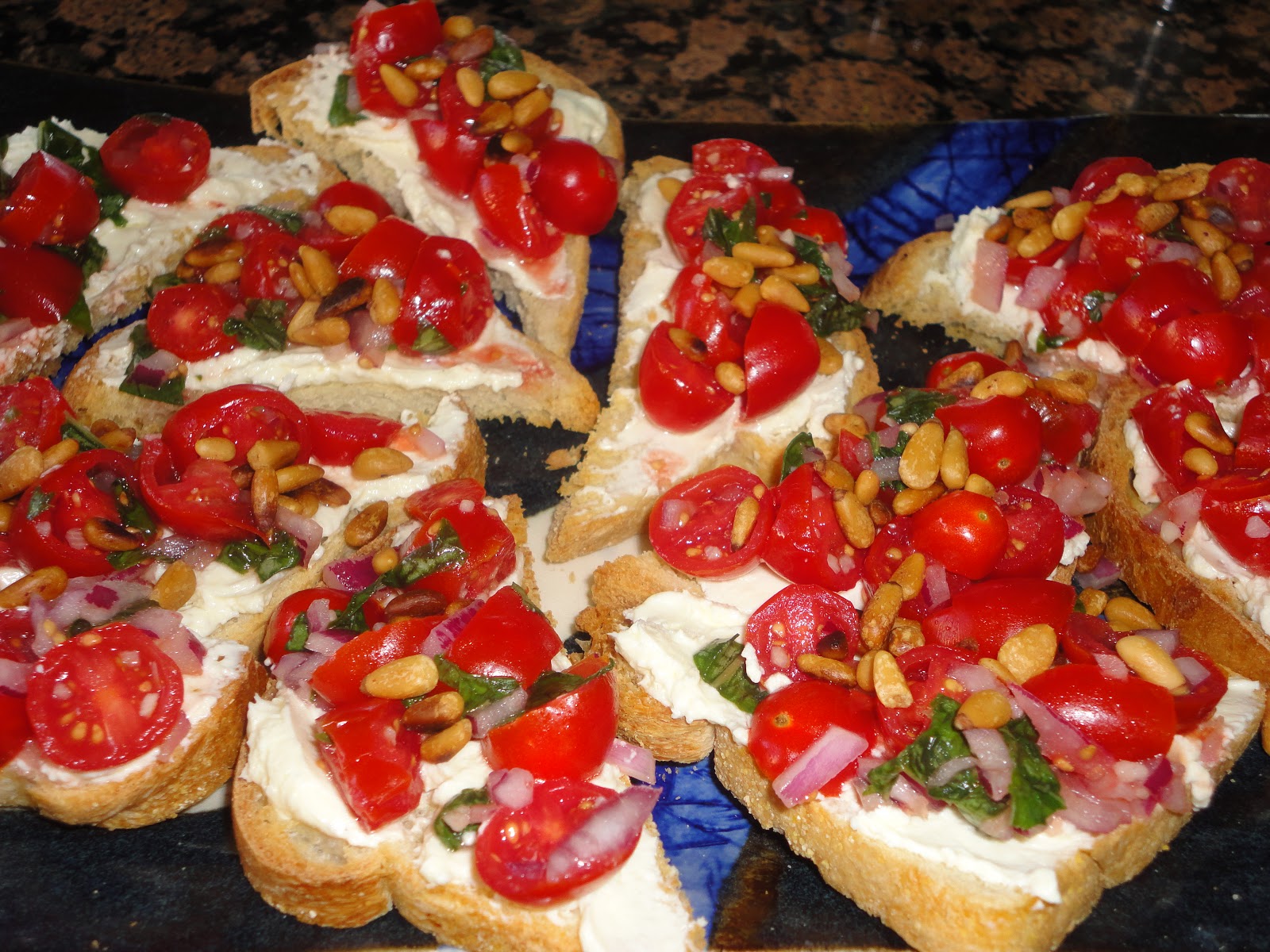
A delicious and lovely Tomato Crostini...perfect colors for the holidays!
(I'd like to take full credit but it is from Barefoot Contessa's new book of "foolproof recipes".  So far so good...I've tried 3 of them.


Tomato Crostini with Whipped Feta

6 oz feta cheese crumbled
2 oz cream cheese at room temp
2/3 cup olive oil   (divided)
2 Tablespoons freshly squeezed lemon juice
Kosher salt and freshly ground pepper
2 Tablespoons minced shallots (1 shallot)
2 teaspoons minced garlic or 2 cloves
2 Tablespoons red wine vinegar
2 lbs. ripe cherry tomatoes-diced in ½ in pieces
2 Tablespoons fresh julienned basil leaves
20-25 diagonal cut baguette slices (I used English muffin sliced bread which I toasted in oven)
2 Tablespoons toasted pine nuts for garnish


Put both cheeses in food processor with steel blade and pulse till blended.
Add 1/3 cup of the olive oil, lemon juice and ¼ teaspoon salt and pepper till all smooth.
Cut up tomatoes about an hour before serving, combine with shallots, garlic, vinegar in a medium bowl. Let sit for about 5 minutes. Whisk in remaining olive oil (1/3 cup) 1 teaspoon salt and ¼ teas. Pepper. Stir gently and set aside for 10 minutes. Stir in the basil and taste for seasoning.

To assemble the crostini, spread each slice of bread generously with whipped feta mixture. With a slotted spoon place the tomatoes on top. Put the crostini on plate and scatter with pine nuts.  Can add additional chopped basil if desired.

This recipe takes a little time, but it is so worth it...both in presentation and taste.

Tuesday, December 18, 2012


“HAVE A WORRIED THOUGHT?

      REPLACE IT WITH A BRAVE THOUGHT”

I read this quote this week in the massive coverage of the Sandy Hook tragedy. I think it was in a letter of advice to parents on how to dispel worries children might voice after experiencing such trauma.  As one young survivor of the tragedy told her mother, “But I just can’t stop thinking about it.”  Mother suggested she replace this worry thought with a brave thought.  What wonderful counseling for a frightened child.

My three –year- old granddaughter Maribelle uses the word brave often. I thought this was kinda peculiar as I don’t recall ever using that word as a child.  But then again she is being raised at West Point Military surroundings with its many statues and memorials where her father talks to her about George Washington and how brave the soldiers were.

Then I thought too of all the countless fairy tales and Disney hero adventures children are exposed to in books, TV and movies.  Brave is BIG.  Brave is even what Princesses now practice. It’s a good thing!

This idea of replacing worry with brave came to mind many times this week as I heard too often how many children were lost and we see little children attending the funeral of little friends.  It is not a pleasant scene, yet it is right to be brave. I think it doesn’t mean we don’t cry. It means we do something that is right even though we might be afraid or uncomfortable.

And I thought, how many adults could use this same mantra?   Who doesn’t want to be brave?  Who wouldn’t want a quick and doable formula for dispelling those worrisome thoughts that creep into our heads as we’re doubting ourselves, or awake in the night imagining the worst, or fearing for a family member’s safe arrival while traveling?  Or giving ourselves a pep talk when facing an uncomfortable situation.

So hopefully out of this horrific tragedy of Sandy Hook-- perhaps something can be salvaged.  A way to teach the living children to deal with fears and worries....something we humans are all plagued with throughout our lives.  Let’s try hard to redeem something good—small as it may be—of this awful event. Let’s be a brave example to those around us—especially children.  And may 20 little souls rest in peace—no longer a need to be brave –simply angelic.


Sunday, December 16, 2012


Lost and Found

I’m SUCH a loser. Now before you try to be kind and tell me I have some redeeming qualities, let me clarify.  I am a loser—literally.  I lose so many things.  Little things, big things, cheap, expensive, important and not so important, but still...
For example, I have a drawer in my jewelry box that contains only single earrings.  I have lost their mates. ( I’ve learned that as soon as I throw out the single, the other one miraculously appears,  in a purse or dangling from a necklace I haven’t worn in ages).

I’m also a leaver. Hats, gloves, scarves, jackets—anything not attached to my body has been left behind somewhere. I hope whoever finds my stuff enjoys it-- small consolation but I hope someone in Boston is now enjoying my favorite fuschia golf cap -- left in the women’s stall at the Boston Acquarium-- or someone in  Newburgh, New York has use for a SONY camera battery and charger which fell out of of carry-on at the airport.

I know now where the expression ”If my head weren’t attached...” comes from. It’s a wonder I didn’t lose Tim or Berta when they were babies.

Latest loss:  Last week I had an audition at the casting studio at noon and a Christmas party there the same night at six. Rather than drive the 50 mile round trip home and back, I decided to hang out at the beautiful Biltmore Shopping Plaza which was just a few miles from the studio.

I had lunch at the Cheesecake Factory and then sat on one of the picnic benches in the promenade—it was a beautiful day.  I made some phone calls and then went window shopping with a final stop at Macy’s. 

Hours later I pulled into the casting studio parking lot a bit early for party and thought I would review the monologue which I was a performing that night.  I had put it in the cover of my Kindle. No Kindle to be found anywhere.  Begins the frantic search and that awful feeling in the pit of the stomach...oh no, not again.  Under car seats, in purses, in bags on seat, glove compartment.  Then I remembered I took the Kindle to lunch with me in case I would read during my solo lunch.

No time to return to the Biltmore.  Frantic memory trace of my steps.  Only purchase was at Macy jewelry department where I bought a pair of earrings for my niece (sorry for plot spoiler if you’re reading this Alycin).  Do you know how hard it is to find a human...”enter your account number, your balance is,  your available credit is...”
Finally... a live voice. Customer service promises to call me should a Kindle turn up.

Then I call Cheesecake Factory. No Kindle there.  I talk to the nicest manager however...SO nice that I sheepishly ask him a stupid question, “I know it’s a long shot but could you please have someone check the picnic bench between you and Paradise Bakery?   This four hours after I sat on the bench...dream on.
 Sure, no problem! I’ll check with the Bakery manager too”.  This young man’s mother would haven been so proud of her son’s courtesy and kindness.

Then one more moment of panic. My credit card number is tied to the Kindle. What if an avid reader, an unscrupulous avid reader found the Kindle and with one touch of the finger starts downloading –every book he or she has ever wanted.  Charged to my card.

I make one more call...Wells Fargo. Please cancel my card.  I know that card is tied in to other automatic payments, but in my best Scarlett O’Hara voice I tell myself I will deal with that tomorrow.

Short story long:  Cheesecake man calls me back. Someone turned Kindle in to Paradise Bakery and he took  it to the mall office.

I think “Yes, Virginia there is a Santa Claus.”

After profound thanks and vowing to eat at the Cheesecake Factory once a week for the rest of my life (what a sacrifice) I go to the party worry-free.

P.S . What prompted this blog was the fact that when I left the house this morning I couldn’t find my favorite Chico jacket...I think I left it on the plane when our red-eye from Hawaii was cancelled.   See what I mean—a literal loser /leaver, whatever.

A final note to my son Tim and DIL Bette Anne:  I’m told grandson Kevin has loser “issues”.  Please don’t be too hard on him.  I think it’s in the DNA.


Thursday, December 13, 2012


Beautiful Ruins by Jess Walter

If you are still looking for a Christmas gift for the reader in your family, male or female, I think they’ll thank you for placing Beautiful Ruins under the tree well into the new year.  And you’ll enjoy the sound of their laughs-out-loud as they turn the pages.

I don’t recall what prompted me to read Beautiful Ruins by Jess Walter a few months ago.  I had never heard of him although he has written five other successful novels, including  The Zero, a National Book Award novel about 9/11 and The Financial Lives of Poets, a satire on our economic crisis.  Nor do I recall anyone recommending the book.  So I am so thankful that somehow I stumbled onto it because it is a GEM. 

I’m going to fudge a little here and copy the description of the book on the front flap of the book cover because it summarizes so much so well (and frankly, I still have a lot of Christmas shopping to do) and then delve into some of my personal favorite highlights.  There is way too much to talk about.  The beautiful and funny writing, the unique and so varied characters, the settings—Italy, Hollywood, Idaho, the Northwest. 

From the book jacket:
The story begins in 1962. On a rocky patch of the sun-drenched Italian coastline, a young innkeeper, chest-deep in daydreams, looks out over the incandescent waters of the Ligurian Sea and spies an apparition: a tall, thin woman, a vision in white, approaching him on a boat. She is an actress, he soon learns, an American starlet, and she is dying.

What unfolds is a dazzling, yet deeply human, roller coaster of a novel, spanning fifty years and nearly as many lives. From the lavish set of "Cleopatra" to the shabby revelry of the Edinburgh Fringe Festival, Walter introduces us to the tangled lives of a dozen unforgettable characters: the star-struck Italian innkeeper and his long-lost love; the heroically preserved producer who once brought them together and his idealistic young assistant; the army veteran turned fledgling novelist and the rakish Richard Burton himself, whose appetites set the whole story in motion--along with the husbands and wives, lovers and dreamers, superstars and losers, who populate their world in the decades that follow. Gloriously inventive, constantly surprising, "Beautiful Ruins" is a story of flawed yet fascinating people, navigating the rocky shores of their lives while clinging to their improbable dreams.

I’ll start my comments with Jess Walter’s writing.  One book reviewer calls his work a literary miracle. Walter captures scenes that create beautiful imagery.  For example, the opening scene in the tiny fictional Italian coastal village of Porto Vergogna

She (the dying American actress) arrived in a boat that motored into the covey, lurched past the rock jetty, and bumped against the end of the pier...All around her shards of sunlight broke on the flickering waves. Twenty meters away Pasquale Tursi was attempting to construct a beach under his family’s empty Pensione (Hotel). He watched as if in a dream or as he would think later, a dream’s opposite--a burst of clarity after a lifetime of sleep.  Chest deep in the cold Ligurian sea, Pasquale was tossing rocks the size of cats in an attempt to fortify the breakwater, to keep the waves from hauling away his little mound of construction sand. Pasquale’s “beach” was only as wide as two fishing boats and the ground beneath his dusting of sand was scalloped rock.  It was the closest thing to a flat piece of shoreline in the entire village. 

When the actress Dee Moray smiles at him Pasquale falls in love and would remain in love for the rest of his life—not so much with the woman, whom he didn’t even know, but with the moment. 

What follows is a description of the ancient dilapidated hotel, the improbable beach designed purposely to attract wealthy Americans such as the Kennedys, the plans to build a tennis court on a jutting piece of rock—all as futile and ridiculous as the name itself: Hotel Adequate View.

Another example of Walter’s way with words:  Porto Vergogna translates as Port of Shame-so called because it was once a place where sailors and sardine fishermen could find women of “a certain moral and commercial flexibility”.

Although filled with boundless comic passages, a favorite I cannot resist enticing you with is that of Michael Deane, the once famous Hollywood producer of the 70’s and 80’s, the “Deane of Hollywood” now reduced to producing a reality dating show called Hookbook. 

The first impression one gets of Deane is a man constructed of wax. It may be impossible to trace the sequence of facials, spa treatments, mud baths, cosmetic procedures, lifts and staples, collagen implants, outpatient touch-ups, tannings, Botox injections, cyst and growth removals and stem-cell injection that have caused a 72-year old man to have the face of a 9-year old Filipino girl.

Trying to picture what Michael Deane looked like as a young man in Italy fifty years ago is like standing on Wall Street trying to understand the topography of Manhattan Island before the Dutch arrived.

Moving on to characters and plots We’ve all read novels with multiple plots emerging and wondering how they would all pull together satisfactorily by the end of the book.  Often, we feel we’ve been manipulated or perhaps the culmination was a little unrealistic.  Not so with this story.  It comes together beautifully and leaves one with a sense that all is well with the human condition.  In a sense it is also good vs. evil (not blatantly like Star Wars) but more like in It’s a Wonderful Life or Willie Wonkie (all good deeds Charlie shall be rewarded...or something like that).

One storyline is with young and very likeable film student Claire, who works for producer Deane reading scripts, hoping to discover the next literary masterpiece but instead being inundated with realty TV show pitches featuring drunk models or sex addicts—scripts so offensive that to give them the green light for production would be akin to “singlehandedly hastening the apocalypse.”  Should she take the new job offer at the new Film Museum-- and while dumping her old job should she also dump her boyfriend whose favorite pastime is girlie shows and strip clubs? 

Then there’s Shane Wheeler, another down on his luck wannabee screenwriter who is about to, against all odds, successfully pitch a movie to Deane called “Donner!” Yes, it’s about the Donner party and story comprises one entire chapter.  We find ourselves also rooting for Shane who for all of his young life lived with the philosophy his loving parents instilled: act as if you can do something and you can do it. This creed has served him well until recently.

Then there is Elvis, a failed American writer and alcoholic veteran. As a once a year visitor to the Hotel Adequate View, he leaves his World War II novel in his room—actually just the lone chapter he continually rewrites every year for two weeks each summer.

Then there is the cameo appearance of the real life Richard Burton who is in Italy for the filming of Cleopatra—the scandal-ridden Elizabeth Taylor/Richard Burton epic, with a budget of about 300 million of today’s dollars.  I thought the title Beautiful Ruins referred to the rock formations on the Italian coast but it appears that Burton himself might be the ruin they are referring to.  They describe a scene where he appeared on the Dick Cavett show in the 80’s, at age 54, looking quite ruined.

And of course, the main characters—Dee Moray, the American actress and Pasquale Tursi.  I do not want to give a plot spoiler and reveal how and why all these characters unite to bring the novel to a satisfying conclusion. Perhaps it is the Hollywood influence but one can almost hear the swelling soundtrack at the end. 

If you are a fan of audio books, I highly recommend that you listen to this one instead of read it as the narrator, Edwardo Balarini,          brings Pasquale to life with his beautiful Italian accent. Ladies, you will fall in love with this sweet and humble, azure-eyed Italian. In my book, he joins the ranks of Heathcliff and Rhett Butler.

Beautiful Ruins is a great escape read and storytelling at its best with the right blend of pathos and comedy.  

Merry Christmas to all ...and to all a good book.


Monday, November 5, 2012


New York the Novel by Edward Rutherford

Edward Rutherford has been writing historical sagas for over twenty years but I just discovered him this summer with New York, the Novel. (2009) After a passionate reading, I wanted heartily to recommend but hesitated—would most readers consider it “old news”?  However, when Hurricane Sandy recently ravaged the East Coast, I felt compelled to do the review as it certainly wrote another chapter in the history of this amazing American city from 1664 to the year 2009.

Rutherford, a disciple of James Michener, spins an 800-page fictional account of primarily one family, the English Masters and their American born descendents, set amidst the background of actual historical events and real people.  You’ll recognize many names from politics to social to cultural, such as George Washington, Abraham Lincoln, Mrs. Astor, the Titanic’s JP Morgan, Boss Tweed, Ben Franklin and Babe Ruth, to name a few.

In a 2009 interview the author says,  “...but it’s the ordinary people I discover in my research—Irish laborers, society ladies, African slaves and sweatshop workers—whose lives move me most and who provide so many of my plots and characters.”   

The story begins in 1664 in Governor Stuyvesant’s Dutch colony New Amsterdam where we first encounter Van Dyke, a wealthy Dutchman, who while trading with the Algonquins  fathers the girl, Pale Feather.  It is here too that we learn the first of interesting tidbits scattered throughout the story in the development of our great nation. For example, why “wampum” was so invaluable in trading and the role felt hats played in our early commerce.  The soft pelt under the beaver’s outer fur was made into felt and felt hats were the height of fashion.  As Van Dyke muses, “there was a certain madness to it....that a whole colony, an empire could be founded, men risk their lives and kill in turn, all on account of a fashionable hat.”  It is this type of detail (and that’s only on page fifteen) throughout the book  (only 845 pages to go) that I found so interesting.  As for the valuable wampum, the belt little Pale Feather makes for her father is passed down through the generations and its destiny is sealed by the end of the book in a tender way that only a master storyteller can weave.

With the British invasion of New Amsterdam, the Dutch colony is lost to the British and given the name of New York, after the Duke of York.   Van Dyke’s daughter Clara marries an American born John Masters and so begins the Master saga. The next 250 pages bring to life the American Revolution where father John Master and son James Master are opposed as Loyalist and Patriot.   “November 25, 1783, at the head of eight hundred Continental troops, George Washington came peacefully down the old Indian trail from the village of Harlem and entered the city of New York.’  As they pass the Master home which survived the fire of 1776, John Master says to his grandson, Weston, “ My dear grandson, the world I knew is turned upside down. So let’s drink to the new one.”


Then comes the emergence of the city as a great trading and financial center, the Gilded Age following the Civil War, the explosion of immigration, the Triangle Shirtwaist Factory fire, World War II, the near-demise of the city in the 70’s and it’s rebirth in the 90’s.  And of course, the attacks on the World Trade Center. Through it all, there is the family drama of the Masters –their successes and failures and human frailties.  It is also the story of families representing the diversity of the city:  the Carusos, (Italians) the O’Donnells (Irish), Quash and Hudson, (slaves), Keller and Adler (German).

Some critics of the book say that in spite of these diverse groups interwoven into the story, New York is mainly the story of conservative well-off whites,  (the Masters) often opportunists, with not enough emphasis on the minority populations’ contribution to the city’s development.  Another criticism is that some important historical events were left out. 

My defense of the author is that this IS a work of fiction in an accurate historical setting and is his choice of what events serve the story best.   To cover 400 years in 800 pages with the human element interest one would have to be somewhat selective of what to embellish to make for an interesting story.  To list every happening like a laundry list or worse yet, like a history textbook, would hardly keep us turning the pages.  Like Michener, Rutherford makes us care about the effect of history on the lives of people...both as individuals and society as a whole.

In the preface Rutherford tells us, “All the families whose fortunes the stories follow are fictional...I have tried to set them amongst people and events that did exist, or might have done.”

For Arizonians who hail from New York, I think it will be a joyful homecoming to experience the origins of familiar landmarks and settings, such as Coney Island, Staten Island, Central Park, particularly the Strawberry Fields, the Dakota Hotel, or the Vanderbilt mansion.  As an infrequent visitor I want to go again with this book in hand and visit these sights with a greater appreciation of their history and evolution. If you lived back east this is the perfect book to curl up with beside the fireplace on a snowy day.  Well, in this case many snowy days as its bulk is no easy feat, but it beckons you like returning to a family and place you now know well.
If you get the paper version, you’ll have the benefit of several maps showing Old New York, Early Manhattan, 19th and 20th Century New York and the current city region.

If English-born Rutherford’s instruction to his children is any indication of how he feels about New York City, we can only assume his love.  Upon his death he requests his ashes to be scattered in the Hudson River.

New York, the Novel received the Langum Prize for American Historical Fiction in 2010.  If you become a fan of Rutherford’s writing style, you’ll be happy to know he has written seven previous historical sagas:  Paris, London, Saurm, Forest (both of England), Russka, and the Dublin Saga with The Princes of Ireland and The Rebels of Ireland.

I find it ironic that not only does the timing of this review tie in with Hurricane Sandy but with our country’s election for our next President. For if this book has a theme, the clue is in the first and last sentence of the novel. Both contain the word “freedom”.  His book, besides being a good story, gives us a great sense of what was sacrificed through the years for this precious freedom that is our right today.


Wednesday, October 10, 2012


The Art of Fielding a novel by Chad Harbach

As the country prepares to enjoy the 108th Baseball World Series, even those who may not be true baseball fans are often caught up in the spirit of America’s national sport.  If you are indeed a die-hard baseball fan, The Art of Fielding by Chad Harbach  might be just the book for you.  But don’t discount it even if you don’t know first base from a knuckle-ball pitch.  Described by one critic as the “greatest baseball novel in a generation”, the sports theme is metaphorically much grander—that of the human condition.

The title, The Art of Fielding, might lead one to believe this is a  how-to-book about baseball.  It is that to some degree but more a reminder that our lives are shaped as much by our mistakes as well as our successes and aspirations.  It is also the story of the fate of five people brought together at Westish College, a small private and fictional school on the shores of Lake Michigan in Wisconsin.

The line up, so to speak, is as follows:

Henry Skrimshander (mostly called Skrimmer):  A scrawny but magically gifted shortstop,  who in his entire high school baseball career has made ZERO errors.  He has committed to memory the philosophy in his personal bible: a fictional baseball handbook entitled The Art of Fielding.  That knowledge, combined with his doggedness determination and a rare innate talent, causes him to become a prized shortstop the major league scouts are clamoring over.  As Henry strives to break records, the tension mounts and makes this page-turner as exciting as bases loaded in a bottom of the 9th tie game.

Mike Schwartz: A student and athlete from Westich, who discovers Henry one summer while playing Legion baseball and recruits him to his college team where he is the catcher and captain. He eventually realizes he has guided Henry’s career at the expense of his own.

Owen Dunne: Henry’s roommate and teammate, who introduces himself to Henry as “I’ll be your gay mulatto roommate. “ Owen becomes caught up in an unexpected affair with the college president.

Guert Affenlight:   The college president, raised to this prestigious rank as a result of an amazing discovery as a Melville scholar in his undergraduate days at Westich.  Hence the Harpooner mascot and the brooding Melville statue that looks out over Lake Michign.  A longtime bachelor, Guert falls hopelessly and unexpectedly in love with Skrimmmer’s roommate,Owen.

Pella, President Affenlight’s daughter who returns to Westich after escaping an ill-fated marriage, determined to start a new life.

The lives of these five people become intertwined and their fates are upended when a routine throw goes disastrously off course for Henry.  As the season counts down to the final climatic game, these five are forced to confront their deepest hopes, as well as their deepest fears.

Author Harbach, a Harvard grad with a MFA pedigree from University of Virginia’s graduate writing program, skillfully combines his encyclopedic knowledge and love  of the game with his passion for literature, citing countless references to Hamlet, Prufrock, Melville, Emily Dickinson and Whitman.   

In an interview last May, the life-long Brewers fan, said, “What fascinates me about baseball is that although it’s a team game and a team becomes a kind of family, the players on the field are very much alone...at the moments that count, they can’t bail you out.  This is the game my father played and the game he taught me...but women seem to like the book more than men.” 

Some critics say this is due to the sensitive exploration of fate and forever friendships, soured dreams and the sweet salvation of second chances.  One phrase I ran across that I particularly liked was, “...it’s intelligent writing filled with the tenderness of youth.” And I might add humor and satire, so much so that it almost bears re-reading to catch what you might have missed the first time around.

Whether you’re a National or American League fan, I think you’ll agree that Harbach’s first novel is a home-run...you might even say a Grand Slam.